


I was recently in a design session, deep in the weeds of architecting a new agentic system. The air in the room was thick with whiteboard marker fumes and technical jargon. We were debating autonomous loops, tool-calling schemas, and reasoning traces, the invisible, messy machinery that makes modern AI actually work.
Then, the executive of the department raised their hand. The room went quiet. I braced myself for a question about latency or cloud costs.
“This looks great,” they said, leaning forward. “But how do I hire one? Like, do we post a job description?”
I nearly choked on my coffee.
I could feel the lead engineer shifting uncomfortably in their seat. To us, the question felt like a category error, like asking how to “interview” a database or “onboard” a microservice. In our world, agents aren’t “staff.” They are infrastructure. They are invisible loops of logic running on a server.
But as the silence stretched on, I realized we weren’t just dealing with a misunderstanding. We were staring across the Semantic Gap.
The Boardroom and the Engineering Floor were looking at the exact same AI system and seeing two entirely different realities. And if we didn’t build a bridge between them fast, this project was going to fall right into the chasm.
The Headcount Hallucination
The executive wasn’t being dense. They were simply using the only mental model available for a system that “acts” and “decides”: Personhood.
It’s not just them. According to recent research by BCG and MIT, 76% of executives now view agentic AI as a co-worker rather than a tool. When an executive looks at an agentic system, they don’t see Python scripts; they see a “Digital Worker” or a “Synthetic Employee.” They want to see an Org Chart. They want to know who is responsible when the “Researcher Agent” hallucinates or forgets to cite its sources.
Meanwhile, on the Engineering Floor, we see a Functional Framework. We see stateful orchestrations, API calls, and probabilistic routers. To us, “hiring” an agent sounds like marketing fluff designed to sell more tokens.
This disconnect is more than a linguistic quirk. It’s an accessibility failure. We are presenting a system to leadership that their mental model cannot parse.
The Architecture of Agency: Microservices 2.0
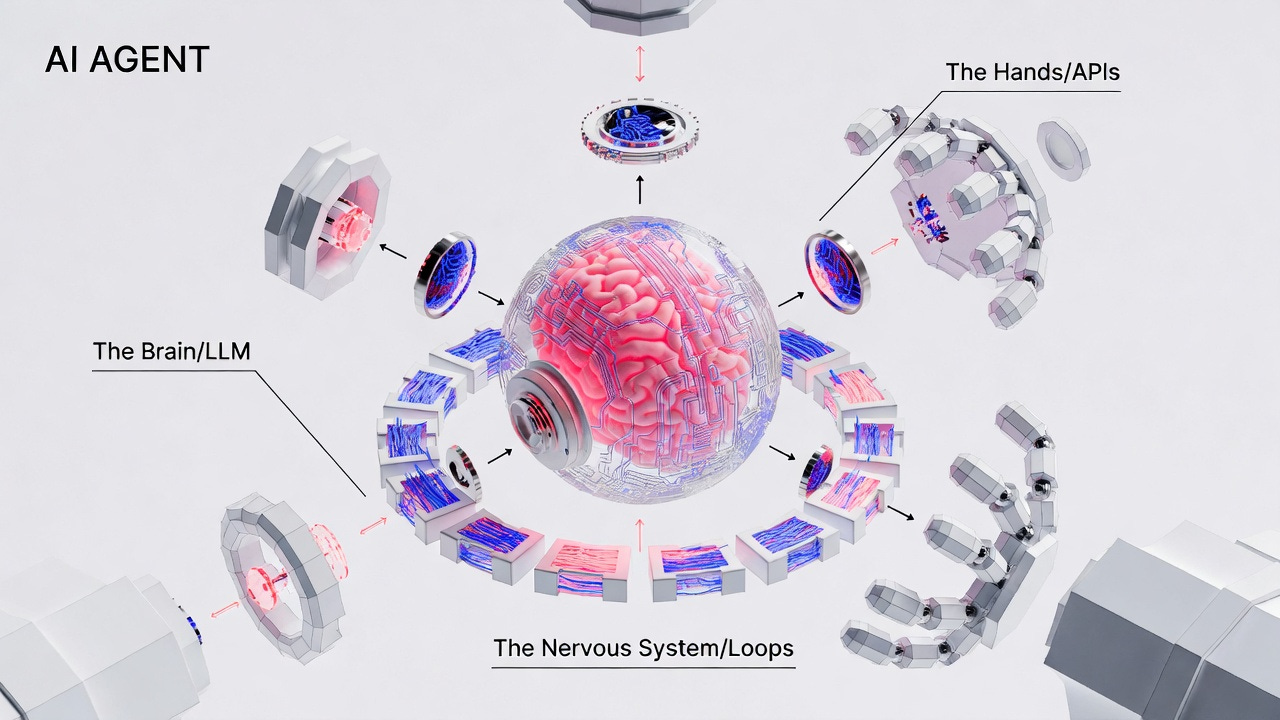
So, what exactly is an agent?
To bridge this gap, we have to stop treating Agents as magic bots and start treating them for what they really are: The evolution of Microservices.
Remember the shift from Monoliths to Microservices? We broke massive apps down into “Bounded Contexts.” The “Inventory Service” handled stock, and the “Billing Service” handled payments. They talked to each other via rigid, pre-defined APIs.
Agents are simply Microservices that learned how to negotiate.
When you look under the hood of a production-grade agent, you don’t find a robot with a personality. You find a mixture of:
APIs: The hands. (e.g., Stripe, Jira, Slack).
Loops: The nervous system. (Control flow for retries and error handling).
LLMs: The brain. (A probabilistic router that decides which API to call next).
This is the “aha!” moment for the Engineering Floor. We aren’t building “Digital People”; we are building Bounded Contexts with Reasoning. The “Sales Agent” is just the “Sales Microservice,” but instead of crashing when it gets messy data, it asks a clarifying question.
The ‘Hiring’ Process (A Guide for the Boardroom)

If you are an executive asking “How do I hire one?”, the answer is simple: You don’t hire them; you architect them.
But the process creates a perfect parallel. When we explain the engineering lifecycle using the language of HR, the “magic” disappears and the business value becomes clear.
It starts with the Job Description. In engineering terms, this is the System Prompt & Tool Definitions. Just as you wouldn’t hire a human without a clear list of responsibilities, you can’t deploy an agent without explicitly defining what it is (and isn’t) allowed to do.
Next comes The Interview. We call these Evals (Evaluations). This isn’t a chat; it’s a stress test. We run the agent through hundreds of hypothetical scenarios to see if it lies, hallucinates, or breaks policy. If it fails the interview, it doesn’t get deployed.
Once hired, the agent needs Onboarding. This is where IAM (Identity Access Management) and RAG (Retrieval Augmented Generation) come in. You give the agent a “badge” (API keys) to access the building, and a “handbook” (Corporate Data) so it knows how the company operates.
Finally, every employee needs a Performance Review. For agents, this is Observability & Tracing. We don’t just trust them to do the job; we monitor every step of their logic chain to ensure they are meeting the standards we set during the interview.
The Rosetta Stone: A Translation Guide
If you are an engineer or architect, your job is to become a translator. We need to stop using “Engineering Speak” in the Boardroom and “Executive Speak” in the terminal. Here is how you bridge the gap in your next meeting:
When you want to discuss Multi-Agent Orchestration, try calling it a Departmental Workflow. Executives understand how departments hand off work; they glaze over when you talk about JSON packets and token passing.
Stop asking for a System Prompt or a Persona. Instead, present it as a Standard Operating Procedure (SOP). An SOP is a tangible business asset that requires budget and maintenance. A “prompt” sounds like a suggestion you whisper to a chatbot.
Perhaps most importantly, reframe Probabilistic Reasoning as Strategic Flexibility. The word “probabilistic” sounds like gambling, it implies the system might fail. “Strategic Flexibility” implies resilience, it tells the business that when the happy path breaks, this system is smart enough to find a new way forward.
Pro Tip: Never sell “Full Autonomy.” It sounds like a liability. Sell “Supervised Delegation.” It tells the executive that the system does the work, but humans set the guardrails.
Accessibility for the Enterprise
At Bioptic Coder, we talk a lot about how “Stronger Glasses” won’t cure a visual impairment if the environment itself isn’t designed for accessibility. You can’t just magnify a broken process and expect it to work.
The same rule applies to AI.
If your engineering team builds a “Black Box” of autonomous loops, they are creating a system that is inaccessible to the business. If a leader can’t “see” the roles and responsibilities within your AI architecture, they can’t trust it, budget for it, or manage it.
Conversely, if the Boardroom demands “Digital Headcount” without understanding that the underlying data is a mess, they are asking for “Stronger Glasses” to look at a blurry backend. You need to build the ramps, the semantic layers and structured data, that allow these agents to actually move through your organization.
The 100x Move: Building the Bridge
The 100x Developer isn’t just someone who can prompt an LLM to write a React hook in record time. The 100x Developer is the one who acts as the Master Agent for the entire enterprise.
They understand that an agent is only as good as the environment it lives in. If an agent can’t navigate your API, it isn’t a “bad hire”—it’s a failure of Intersystem Accessibility.
So, the next time a stakeholder asks, “How do I hire one?”, don’t roll your eyes. Don’t explain Python loops. Channel the 100x mindset and say:
“We are building a Digital Department. It has three specialized roles—a Researcher, an Auditor, and a Clerk. We are writing their Job Descriptions (System Prompts) today, and we’ll start their Interviews (Evals) next week.”
The Shared Definition of “Done”
The goal of Agentic AI isn’t to replace humans or to build the most complex loop possible. It’s to create a system where the Vibe of the business intent is accurately reflected in the Architecture of the code.
Stop asking “How many?” and start asking “What outcome?”
When the Boardroom and the Engineering Floor finally start speaking the same language, we won’t need “stronger glasses” to see the future of AI. The vision will be clear for everyone.
What’s the biggest “lost in translation” moment you’ve had with AI? Share it in the comments below!